|
|
Brief
Curricula
Vitae
(updated 03/17/26)
Robert and
Suzanne Mays have studied the
phenomena related to near-death experiences
(NDEs) together for over 40 years, although
neither has had a near-death experience. They
began active research on NDEs in 2005.
Research
areas
Phenomena
connected
with near-death experiences (NDEs) and
shared-death experiences (SDEs) and their
implications for understanding consciousness
and neurological function, in particular:
- The
phenomena
connected
with the out-of-body component of NDEs,
especially veridical perceptions during
NDEs and SDEs, and apparent interactions
during NDEs between the NDEr and physical
reality.
- Neurological
evidence
of the nonmaterial mind during ordinary
consciousness, especially in memory
formation and recall.
- Neurological
mechanisms
for an interface between the “mind” and
the brain, including experiments on
interactions of the human bioenergy field
with physical processes such as
fluorescent materials and photographic
paper.
- Phenomena
from
NDEs such as NDEr experiences interacting
with physical matter, NDEr altered spatial
and time perceptions, the life review and
life preview, etc. that give insights into
the true nature of the self and of
reality.
- Verification
and
corroboration
of specific veridical perceptions during
an NDE, such as those of George Ritchie.
- Specific
research on phantom limbs, focusing on
perceivable interactions with another
person’s body and measurable interactions
with physical processes.
|
|
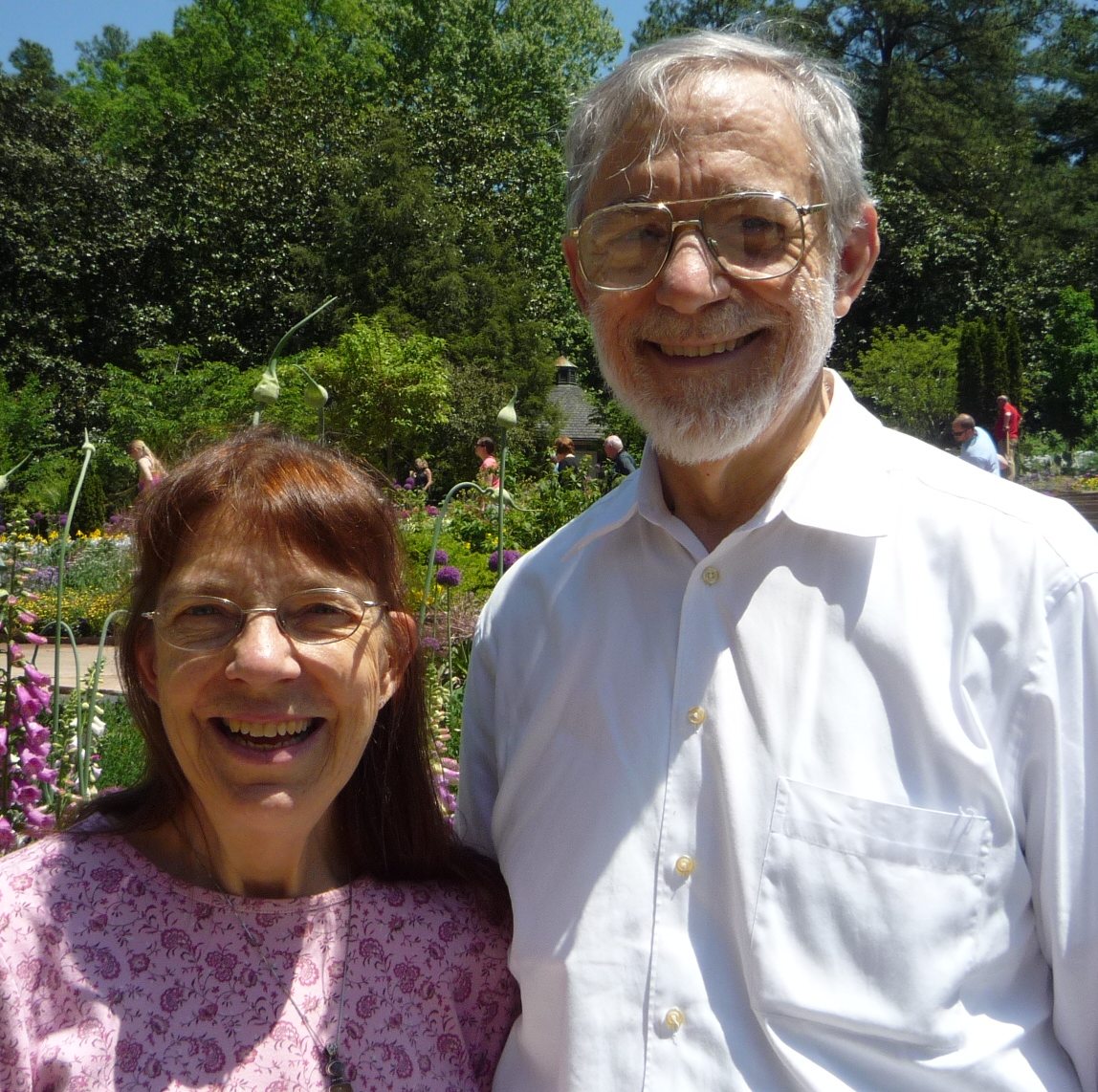
Suzanne and Robert Mays
at Duke Gardens, May 2014 |
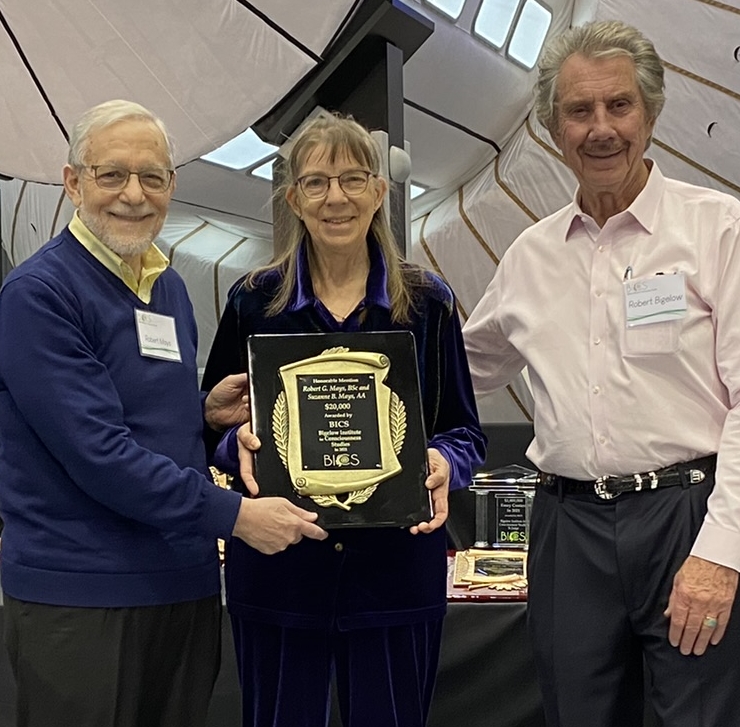
Robert and Suzanne
Mays
with Robert Bigelow at the BICS Award
Ceremony, December 4, 2021
|
Our jointly authored
publications include:
- Mays, R. G., & Mays, S. B. (2024).
Near-death experiences are caused by the
separation of consciousness from the body. Journal
of Scientific Exploration, 38(2),
190–211. (abstract
and preprint).
- Mays, R. G., & Mays, S. B. (2021). There
is no death: NDE evidence for survival after
permanent bodily death. Paper was awarded
honorable mention in the Bigelow Institute for
Consciousness Studies 2021 contest. (abstract and PDF).
- Mays, R. G., & Mays, S. B. (2020).
Near-Death Experiences: Extended naturalism or
promissory physicalism? A response to
Fischer's article. Journal of
Consciousness Studies, 27(11–12),
222–236. (abstract and preprint).
- Mays, R. G., & Mays, S. B. (2017).
Near-Death Experiences: A critique of the
Fischer and Mitchell-Yellin physicalist
interpretation, with Response and Rejoinder. Journal
of Near-Death Studies, 36(2), 69–99. (abstract
and reprint).
- Mays, R. G. (2016). Eben Alexander's
near-death experience: How an Esquire
article distorted the facts. Journal of
Near-Death Studies, 35(2), 65–93. (abstract and reprint).
- Mays, R. G., & Mays, S. B. (2016).
Foreword to the English edition of The Self Does
Not Die: Verified paranormal phenomena from
near-death experiences by Titus
Rivas, Anny Dirven and Rudolf Smit. (reprint).
- Mays, R. G., & Mays, S. B. (2015).
Explaining Near-Death Experiences: Physical or
Non-physical Causation? Journal of
Near-Death Studies, 33(3), 125–149. (abstract
and reprint).
- Mays, R. G., & Mays, S. B. (2011). A
theory of mind and body that solves the "hard
problem" of consciousness. Paper presented at
2011 IANDS Conference (Durham, September
2011). (abstract
and manuscript, slides
and
video).
- Mays, R. G., & Mays, S. B. (2010). A
theory of mind and body that solves the "hard
problem". Poster presentation at the Toward a Science
of Consciousness conference (Tucson,
Arizona, April 13–17, 2010). (abstract and
reprint).
- Mays, R. G., & Mays, S. B. (2008). The
phenomenology of the self-conscious mind. Journal
of Near-Death Studies, 27(1), 5–45. (abstract and
reprint).
- Mays, R. G., & Mays, S. B.
(2008). Phantom limb "touch" suggests
that a "mind-limb" extends beyond
the physical body. Poster presentation at
the Toward
a Science of Consciousness conference
(Tucson,
Arizona, April 8–12, 2008). (abstract and
reprint).
Awards: Honorable Mention in Bigelow
Institute for Consciousness Studies essay contest,
2021. $20,000 award. Co-recipient of an IBM
Corporate Quality Award, for the development and
dissemination of the defect prevention process,
1991. $30,000 award.
Robert G. Mays received
a Bachelor of Science degree in chemistry from
MIT and worked in software development at
Eastman Kodak and later at IBM for more than 30
years, where he achieved the level
of Senior Software Engineer. At IBM he
specialized in software development process,
software quality and software defect prevention.
He was a co-recipient of IBM's first Corporate
Quality Award in 1991. He was one of the
co-founders of the Emerson Waldorf School. After
leaving IBM, he taught high school chemistry for
several years at different Waldorf schools
in the U.S. and is now retired. He is a Life
Senior Member of the Institute of Electrical and
Electronics Engineers (IEEE).
Additional
coursework: Medical Neuroscience,
Clinical Neurology, Biomedical Imaging,
Fundamentals of Neuroscience
Other
publications
- Mays, R. G. &
Stubbs, T. M. (1997). Software understanding
aid for generating and displaying simplified
code flow paths with respect to target code
statements. International Business Machines
Corporation, U.S.
Patent 5,652,899.
- Mays, R. G.
(1994). Forging
a
silver bullet from the essence of software,
IBM Systems
Journal, 33(1), 20–45.
- Mays, R. G.
(1990). Applications
of
defect prevention in software development,
IEEE Journal
on Selected Areas in Communications, 8,
164–168.
- Mays, R. G.,
Jones, C. L., Holloway, G. J., Studinski, D.
P. (1990). Experiences
with defect prevention, IBM Systems
Journal, 29(1), 4–32.
- Mays, R. G.,
Orzech, L. S., Ciarfella, W. A., &
Phillips, R. W. (1985). PDM:
a requirements methodology for software
system enhancements, IBM Systems
Journal, 24 (2).
- Higgins, T., &
Mays, R. (1970). A solution to the ASIS file
management system exercise using PL/I and
three general purpose systems. Journal of
the American Society for Information
Science, 21(3), 209–213.
Suzanne
B. Mays received an Associate
in Applied Science degree in medical secretarial
science from Alfred State College (SUNY),
Alfred, NY and is a Certified Music Practitioner
with training through the Music
for
Healing and Transition Program. As a
Certified Music Practitioner, she provided
palliative care to patients at UNC Hospitals and
Duke University Medical Center. She was one of
the co-founders of the Emerson Waldorf School.
She also teaches lyre privately and at the
Emerson Waldorf School.
|
|