Research
papers
(updated
05/04/26)
Preprint paper (May,
2026).
Framework
and Mechanism for Mind-Brain Interaction
based on NDE and neurological evidence --
extended
Robert G. Mays, BSc, and Suzanne B. Mays,
AAS
ABSTRACT: We
propose a new substance dualist framework to
explain consciousness, drawing on near-death
experience (NDE) and neurological evidence.
Evidence from veridical NDE perceptions suggests
that consciousness can separate from the
physical body as an individuated, self-aware
entity or mind. We propose that the mind is a
separate entity from the physical body,
belonging to a distinct ontological category.
Accordingly, the human being is conceptualized
as the union of the mind entity (or soul) and
the physical body. As the locus of
consciousness, the mind entity possesses all the
attributes of consciousness: perception,
thinking, emotion, memory, volition, and
self-awareness. We provide NDE evidence that the
mind entity interacts in general with physical
processes and specifically with neural activity
in the brain. The mechanism for mind-brain
interaction involves initially triggering and
then detecting neural action potentials. The
induced neural activity in specific regions
brings the mind’s mental content to awareness.
The mind-brain interface occurs in cortical
dendritic spines, where the mind triggers
calcium ion release from the spine apparatus via
spine F-actin filaments. Inhaled anesthetics
dissolve these filaments, blocking this process,
leading to loss of consciousness. The mind
entity’s actions to induce cortical activity can
explain numerous cognitive neurological
processes including perception and language
comprehension.
PDF
(2.0 MB, 50 pages).
Published in the Journal of
Scientific Exploration, 38(2), 190-211
(2024).
Near-death
experiences are caused by the separation of
consciousness from the body
Robert G.
Mays, BSc, and Suzanne B. Mays, AAS, CMP
ABSTRACT: Near-death
experiences (NDEs) cannot be defined merely as a
collection of phenomenal features. An accurate
definition needs to describe what NDEs
essentially are, that is, what lies
behind the phenomenal features.
The definition would describe what
happens in the experience to account for the
different features; this can only be fully
described in the context of an underlying
theoretical framework. In this paper, we propose
the mind entity framework, which holds that a
human being is a nonmaterial mind united with
the physical body. In an NDE, the mind, or seat
of consciousness, separates from the body and
operates independently of it until the mind
returns to and reunites with the body. From this
framework, we identified the nine NDE features
from the 16 features of the NDE Scale (Greyson,
1983) that specifically imply the separation of
the mind from the body. The five most prevalent
of these “separation” features accounted for
98.8% of NDEs in a sample of NDE accounts in the
IANDS Experience Registry (N=565). The
prevalence of these five “essential” NDE
features was repeated in three other large NDE
datasets published in the last 20 years.
Therefore, an NDE can be defined as a profound
subjective experience caused by a person’s
consciousness separating from their physical
body.
PDF
(0.7 MB, 22 pages).
NDE
Evidence that there is No Death: slides
presented
at the 2021
IANDS Conference (online, September
2021).
NDE
Evidence that there is No Death
Robert G.
Mays, BSc, and Suzanne B. Mays, AAS, CMP
ABSTRACT: Near-death
experiences (NDEs) provide five main areas of
evidence that there is no death. First, NDE
evidence of veridical perceptions in the
physical realm during cardiac arrest or coma
imply that the mind separates from the physical
body and operates independent of it. In
addition, apparitional NDEs show that the mind
is an objectively real entity. Secondly, there
is strong NDE evidence that the separate mind
entity interacts with physical processes
including neural activations in the brain to
produce awareness. Thirdly, the continuity of
awareness throughout NDE, especially involving
deceased persons, are implicit evidence of
personal survival after death, especially when
the decedent was not known to the NDEr or was
known but was not known to have died. Fourth,
shared death experiences (SDEs), including
veridical perceptions and shared life reviews,
show a continuity from an NDE to the
transmaterial realm at the time of physical
death. Finally, after-death communications
(ADCs) indicate that the decedent’s
consciousness and identity continue on after
death.
PDF
(1.8 MB, 21 pages).
A New
Scale to Assess Near-Death Experiences: article
(February 2021).
A New Scale to
Assess Near-Death Experiences--Commentary
Robert
G.
Mays, BSc, and Suzanne B. Mays, AAS, CMP
ABSTRACT: An expanded scale,
the Near-Death Experience Content (NDE-C) scale,
has been developed by Charlotte Martial and
colleagues (2020) to assess near-death
experiences (NDEs). The scale was modeled after
the existing NDE Scale (Greyson, 1983), using
reworded scale items, and added five additional
items, notably items about a gateway or tunnel
and a feeling of non-existence or fear. NDE-C
uses a rating scale of 0–4 for each item and
thus ranges from 0 to 80. In this article, we
raise concerns that several of the reworded
items appear to have changed the meaning of the
NDE Scale item and appear to be significantly
more prevalent or less prevalent than the
original item, as demonstrated in a Rasch
statistical analysis of the NDE-C results. We
suggest wording changes for these items so that
they return to their original context and
meaning.
PDF (0.8 MB, 14 pages).
Published in the Journal of
Consciousness Studies, 27(11-12), 222-236
(2020).
Near-Death
Experiences: Extended naturalism or
promissory physicalism? A response to
Fischer's article
Robert
G.
Mays, BSc, and Suzanne B. Mays, AAS, CMP
ABSTRACT: In this commentary,
we respond to Fischer’s main thesis—“I do think
that mainstream science could in principle
someday explain NDEs (although it hasn’t yet)”
(Fischer, 2020, p. 174). We draw on earlier
points we published in two critical articles in
the Journal of Near-Death Studies (Mays &
Mays, 2015, 2017a). In this article, we refer to
the book, The Self Does Not Die (SDND) by Titus
Rivas et al. (2016), which we consider an
excellent compendium of verified paranormal
phenomena reported in association with NDEs. Our
argument touches on (1) Fischer's reliance on ad hoc
hypotheses, (2) Promissory physicalism or a
paradigm shift, (3) Our mind-entity hypothesis,
(4) Explanatory power, and (5) Extending
physicalist naturalism.
Preprint: PDF (0.3 MB, 10 pages).
NDEs, Consciousness, and Reality:
slide presentation of the main results of the
past 15 years of our research (2020).
NDEs,
Consciousness, and Reality
Robert G. Mays, BSc, and Suzanne B.
Mays, AAS, CMP
 The
main results of the past 15 years of our
research -- the mind-entity hypothesis and the
transcendent realm hypothesis.
Color slides ( PDF, 3.3 MB, 38
pages). Video
of this presentation (80 min).
The Self Does Not Die:
Paranormal phenomena in NDEs: slide
presentation at IANDS Utah meeting (Salt Lake
City, Utah, May 2019).
The Self Does
Not Die: Paranormal phenomena in NDEs
Robert G. Mays, BSc, and Suzanne B.
Mays, AAS, CMP
 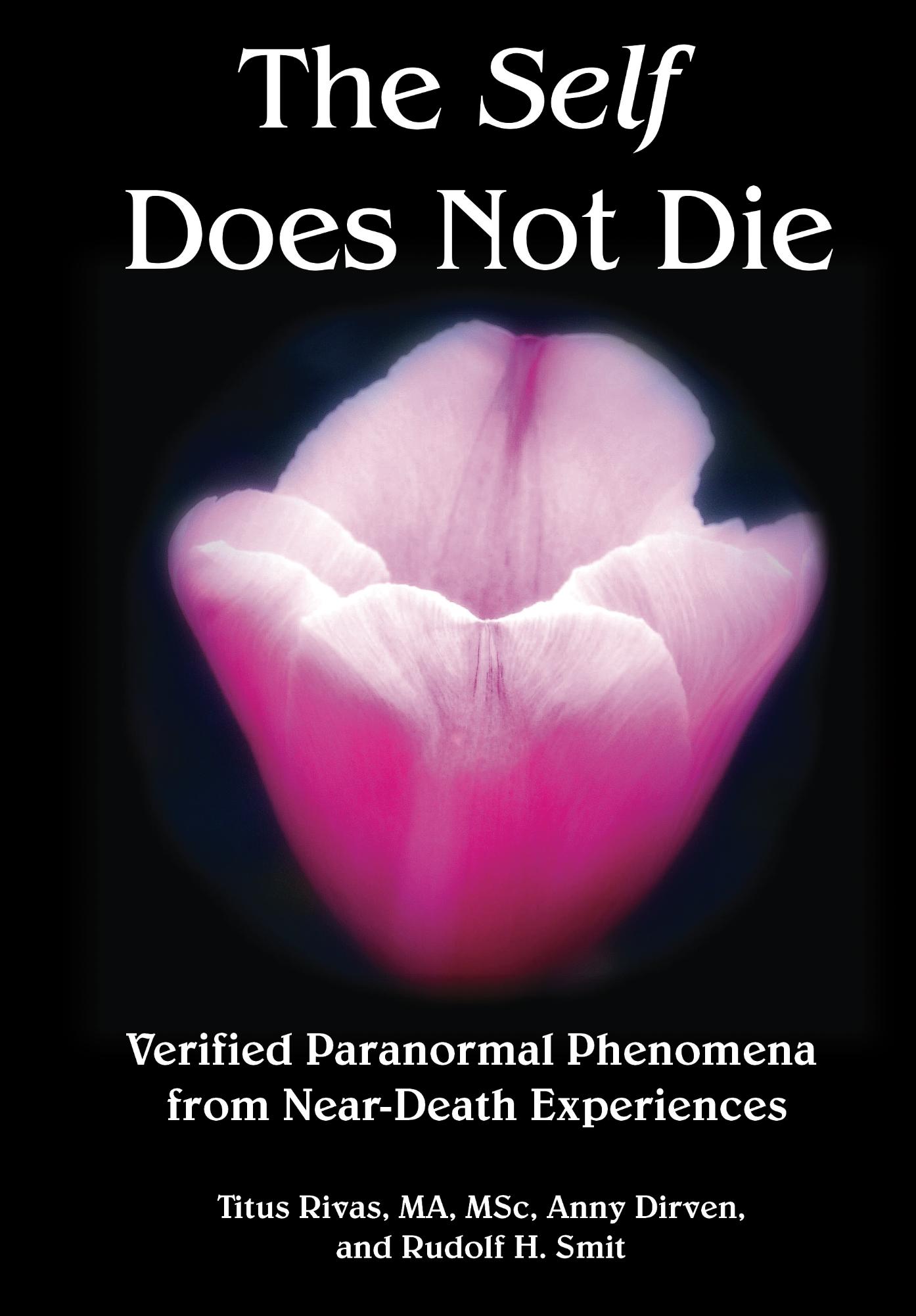 2019
lecture at IANDS Utah Group in Salt Lake City on
the book The Self Does Not Die by Titus
Rivas, Anny Dirven & Rudolf Smit.
The book is available at Amazon.
Color slides ( PDF, 2.3 MB, 22
pages). Video
of this presentation (88 min).
NDEs:
Insights into Mind, Consciousness and Reality:
slides presented at the 2018 Natural
Science Section meeting (Spring Valley,
New York, November 2018)
NDEs: Insights
into Mind, Consciousness and Reality
Robert G. Mays, BSc, and Suzanne B.
Mays, AAS, CMP
 Based
on
evidence from NDEs, we present two major
hypotheses: (1) the Mind-Entity Hypothesis, that
the mind is an autonomous nonmaterial aspect of
a person that separates from the physical body
during an NDE; and (2) the Transcendent Realm
Hypothesis, that (a) reality consists of the
physical realm plus a more fundamental
"transcendent realm" which is actually a 5th
dimension of reality; (b) all experiences in
life are recorded in a "Book of World Memory"
that is part of the fabric of reality; (c) one
has free will in one's actions; and (d) there is
a plan and purpose for one's life.
Intro:
00:00 - Background and history of our research
Part1: 02:40 - NDEs and the mind-entity
hypothesis
- 05:58 - NDE phenomena implying a separation
of the mind from the body
- 11:46 - Can NDEs be studied scientifically?
- 15:43 - The mind-entity hypothesis
- 17:48 - Mind-matter interactions in NDEs and
a new physical force
- 23:58 - The mind-brain interface
- 28:49 - Q&A -1
Part2: 29:38 - The process of ordinary
mind-brain consciousness
- 30:13
- Experiences of visual perception: rapid
visual categorization
- 34:35 - Experiences of visual perception:
two steps in recognition
- 38:47 - The implied operation of the mind
and brain
- 41:57 - The process of perception &
comprehension (EEG/MEG examples)
- 48:16 - Constraints on mind-brain functional
interactions
- 52:32 - Mind-brain interactions during
perception & comprehension
- 59:02 - Mind is involved in both sensory and
default networks
- 1:03:29 - Q&A -2
Part3: 1:07:31 - NDEs and the
transcendent realm hypothesis
- 1:11:41 - NDEr hyperdimensional perceptions
- 1:17:35 - Flatland thought experiment
- 1:22:17 - A 5th dimension of reality
- 1:25:51 - NDEr life review and life preview
- 1:36:11 - The Book of World Memory/Akashic
Record and free will
- 1:37:44 - The plan and purpose for one's
earthly life
- 1:41:01 - Q&A -3
Color slides ( PDF,
3.4 MB, 44 pages). Video
of this presentation (114 min).
NDEs:
Elucidating the True Nature of Reality:
slides presented at the 2018 IANDS
Conference (Bellevue, Washington,
August 2018)
NDEs: Elucidating
the True Nature of Reality
Robert G. Mays, BSc, and Suzanne B.
Mays, AAS, CMP
 Near-death
experiences
(NDEs) imply that there is a transmaterial,
transcendent aspect to human beings. NDErs
report hyperreal experiences of both the
physical realm and a transcendent realm. In both
realms, NDErs report obtaining veridical
information that would be impossible through
ordinary physical senses and report encounters
with deceased persons and spiritual beings.
NDErs frequently describe a transition between
the two realms. We propose that the physical and
the transcendent or spiritual realms are both
real. From NDE evidence, the transcendent realm
interpenetrates and is coextensive with the
physical realm and is more fundamental than the
physical–it is a “fifth dimension” of reality.
Human beings are transcendent, spiritual beings
united with a physical-energetic bodily sheath.
There is confirmatory evidence of this view from
such death-related phenomena as veridical shared
death experiences, veridical after-death
communications, veridical mediumship
communications and verified cases of
reincarnation memories. Other theories of
consciousness proposing that transcendent
phenomena derive from nonlocal, quantum-level
physical phenomena fail to explain the NDE
phenomena fully, in particular NDErs’ experience
as an individuated spiritual being encountering
other individuated spiritual beings. This view
helps elucidate ultimate questions: Who am I?
What is the purpose of physical life? Why does a
loving God allow suffering and evil to exist?
Color slides ( PDF,
14.1 MB, 25 pages). Video of this presentation
(63 min).
Published in the Journal of
Near-Death Studies, 36(2), 69-99
(2017).
Near-Death
Experiences: A Critique of the Fischer and
Mitchell-Yellin Physicalist Interpretation,
with Response and Rejoinder
Robert
G.
Mays, BSc, and Suzanne B. Mays, AAS, CMP
ABSTRACT: In Near-Death
Experiences: Understanding Visions of the
Afterlife, authors John Martin Fischer
and Benjamin Mitchell-Yellin (2016) argued for
purely physicalist explanations of near-death
experiences (NDEs) and against “supernatural”
explanations involving objects and
events—out-of-body experiences, heavenly realms,
meeting deceased relatives—that have no physical
reality. In our critique, we identify two major
weaknesses to their argument: heavy reliance on
ad hoc
hypotheses and frequent appeal to “promissory
materialism.” Fischer and Mitchell-Yellin
applied the term “hallucination” to NDEs
because, by definition, they “do not correspond
to reality.” We found use of this term
problematic for several reasons: that NDE
perceptions are phenomenologically different
from hallucinations, that NDE perceptions of the
physical realm are nearly always veridical, and
that labelling NDEs “hallucinations”
pathologizes a normal, subjective experience,
with potentially harmful psychological outcomes.
Although Fischer and Mitchell-Yellin argued
against a theory of NDEs that invokes only one
explanatory factor, we argue for a likely common proximate
cause for all NDEs and that the
nonphysical “mind-entity theory,” in which the
nonmaterial mind separates from the physical
body in an NDE, is a likely candidate theory
with good explanatory power. We believe that
ultimately the theory explaining NDEs will be
corrected through the normal process of
scientific inquiry, resulting in an expansion
of current physicalist theory to include what is
now considered supernatural, thus becoming an extended,
transmaterial naturalist theory.
Reprint: PDF (1.4 MB, 52 pages).
NDEs and the Neural
Correlates of Consciousness: slides
presented
at the 2017
IANDS Conference (Westminster,
Colorado, August 2017)
NDEs and the
Neural Correlates of Consciousness
Robert G. Mays, BSc, and Suzanne B.
Mays, AAS, CMP
 The
phenomenology of near-death experiences (NDEs)
strongly suggests the existence of a separate,
autonomous mind or psyche. In an NDE, the mind
exists and operates independent of the physical
brain and body, having (1) a sense of separation
from the body, with freedom from pain and
disabilities; (2) lucid thought processes and
hyperreal perceptions with veridical information
beyond ordinary physical senses and prior
knowledge; (3) real, albeit subtle, interactions
with physical processes; and (4) accurate memory
recall of past events and the formation of
vivid, indelible memories of NDE events. In some
cases, the mind entity can be seen and heard
objectively by others at a distance from the
body. If the mind entity is real, there should
be ample evidence of its presence in brain
processes during ordinary waking consciousness.
We propose that the two neural correlates of the
mind-brain interface are (1) the characteristic
pauses in neural activation seen in
brain EEG and MEG recordings, indicating mental
activity during such cases as perception,
language comprehension and working memory; and
(2) the characteristic increases in
neural activation in progressive brain regions,
indicating the process of the mental content
coming to consciousness from unconscious
detection to full awareness. We present examples
of interpreting patterns in EEG and MEG
recordings in rapid visual categorization,
auditory and visual language comprehension and
face recognition tasks. The mind-entity
hypothesis has greater explanatory power over
physicalist brain-production theories in
explaining not only the phenomena associated
with NDEs but also ordinary neurological
phenomena like perception and language
comprehension, as well as a number of the
enigmas of consciousness, such as the “hard
problem” and the “binding problem.”
Color slides ( PDF,
3.2 MB, 36 pages). Video of this presentation
(58 min).
Published in the Journal of
Near-Death Studies, 35(2), 65-93
(2016).
Eben Alexander’s
Near-Death Experience: How an Esquire
Article Distorted the Facts
Robert
G.
Mays, BSc
ABSTRACT: In July 2013,
journalist Luke Dittrich wrote an article in Esquire
magazine critical of neurosurgeon Eben
Alexander’s 2012 book Proof of Heaven. Dittrich
cited several malpractice lawsuits against
Alexander, in one of which Alexander allegedly
had altered medical records to cover his errors.
Dittrich made this allegation his theme for
critiquing the story of Alexander’s NDE: that
Alexander altered the facts of his story to make
them more dramatic. In particular, Dittrich
questioned the central premise of the book: that
Alexander’s experience was the result of a brain
all but destroyed by meningitis. He contended
that Alexander’s hyperreal experience of the
heavenly Gateway Realm with the beautiful girl
on the butterfly wing and the knowledge he
gained from The Core were all hallucinations
resulting from a medically induced coma and that
Alexander stood to gain financially by
representing his experience as genuine. In this
article, I critique Dittrich’s article point by
point and uncover a pattern of inaccuracy and
misrepresentation of facts on Dittrich’s part. I
conclude that it was Dittrich’s work, rather
than Alexander’s, that was erroneous.
Reprint: PDF
(0.7 MB, 29 pages).
Unraveling
the Mystery of Memory through Near-Death
Experiences: slides
presented at the 2016 IANDS Conference
(Orlando, Florida, July 2016)
Unraveling the
Mystery of Memory through Near-Death
Experiences
Robert G. Mays, BSc, and Suzanne B.
Mays, AAS, CMP
 Near-death
experiencers (NDErs) report that the memory
of their NDE is more vivid and lucid than
ordinary memories. Two recent analyses of
NDE memories showed that they have
significantly more characteristics, like
visual details, memory clarity,
self-referential information (being involved
in the event) and emotional content than
both memories of real events and imagined
events. In addition, the EEG patterns in
NDErs differ significantly in several
characteristics when the NDErs recall their
NDE than non-NDErs when they recall real or
imagined events. The hypothesis that the
non-material mind separates from the
physical body during an NDE is consistent
with these findings. According to the
hypothesis, when the mind is separated from
the body, sensations are experienced
directly rather than through the physical
senses and the memories are recorded
directly in the mind rather than through the
hippocampus. The recall of NDE memories
would then use different pathways and
electrical patterns than ordinary recall of
episodic memories. Indeed, we hypothesize
that the recall of NDE memories involves an
altered state of consciousness which is more
like a re-living of the experience than
simply recalling a series of events. The
evidence from NDEs supports the idea that
memories in general are stored in the
non-material mind rather than as pattern
encodings in neural structures. Ordinary
episodic memories are recorded in the mind
through pathways in the hippocampus and are
recalled again from the mind through reverse
hippocampal pathways that reactivate the
same sensory and mental neural components,
but at a lower intensity. Near-death
experiencers (NDErs) report that the memory
of their NDE is more vivid and lucid than
ordinary memories. Two recent analyses of
NDE memories showed that they have
significantly more characteristics, like
visual details, memory clarity,
self-referential information (being involved
in the event) and emotional content than
both memories of real events and imagined
events. In addition, the EEG patterns in
NDErs differ significantly in several
characteristics when the NDErs recall their
NDE than non-NDErs when they recall real or
imagined events. The hypothesis that the
non-material mind separates from the
physical body during an NDE is consistent
with these findings. According to the
hypothesis, when the mind is separated from
the body, sensations are experienced
directly rather than through the physical
senses and the memories are recorded
directly in the mind rather than through the
hippocampus. The recall of NDE memories
would then use different pathways and
electrical patterns than ordinary recall of
episodic memories. Indeed, we hypothesize
that the recall of NDE memories involves an
altered state of consciousness which is more
like a re-living of the experience than
simply recalling a series of events. The
evidence from NDEs supports the idea that
memories in general are stored in the
non-material mind rather than as pattern
encodings in neural structures. Ordinary
episodic memories are recorded in the mind
through pathways in the hippocampus and are
recalled again from the mind through reverse
hippocampal pathways that reactivate the
same sensory and mental neural components,
but at a lower intensity.
Color slides ( PDF,
8.5 MB, 32 pages). Video of this presentation
(55 min).
Published in the Journal of
Near-Death Studies, 33(3), 125-149
(2015).
Explaining
Near-Death Experiences: Physical or
Non-physical Causation?
Robert
G.
Mays, BSc, and Suzanne B. Mays, AAS, CMP
ABSTRACT: A recent comparison
of near-death experiences (NDEs) occurring with
life-threatening events leading to coma to
“NDE-like” experiences occurring with
non-life-threatening events showed no
significant difference in intensity or content
between the two experiences, suggesting that
neither the apparent proximity to death nor the
specific physiological or psychological factors
present influence quality or “depth” of such
experiences. This study directly contradicts
previous findings of significantly more enhanced
perception of light and enhanced cognitive
powers in near-death experiencers (NDErs) very
close to death compared to those not in danger
of dying. We argue that findings of the recent
study are more valid due to more appropriate
methodology. The general assumption has been
that NDEs result from some physical cause that
brings people close to death, but such
explanations are problematic. An adequate
scientific explanation of NDEs needs to be
complete, accounting for all aspects of all
NDEs. The commonality among NDEs occurring in a
wide range of conditions suggests that there is
a common underlying “proximate cause” to all
NDEs. The proximate cause could be
physiological, for example, a common brain
circuit in a particular brain region, or
non-physiological, for example, the separation
of consciousness as an autonomous entity from
the physical body. We argue that the latter
hypothesis has greater explanatory power,
although it posits elements beyond the current
physicalist paradigm. Which explanation of NDEs
is correct will be resolved only with further
scientific investigation.
Reprint: PDF (0.6 MB, 25 pages).
The
Importance of Veridical Perceptions and
Veridical Information in NDEs: slides
presented at the 2015 IANDS Conference (San
Antonio, Texas, September 2015)
The Importance of
Veridical Perceptions and Veridical
Information in Near-Death Experiences
Robert G. Mays, BSc, and Suzanne B.
Mays, AAS, CMP
 Investigation of apparently
non-physical veridical perceptions (AVPs) during
NDEs has been the subject of much experimental
and phenomenological research since 1988. Jan
Holden’s study (2006/2009) showed that over 90%
of cases of AVPs from NDE literature were
completely accurate. The multi-hospital AWARE
(AWAreness during REsuscitation) study of NDEs
during cardiac arrest has a major objective of
detecting possible AVPs of hidden visual
targets. It is important now to look
systematically at AVP cases in detail, to
include only cases of AVPs that were
independently verified to researchers by another
person and to include important recent cases.
With the sheer number of AVP cases, the weight
of the evidence becomes daunting to those who
would dismiss the fact that AVPs occur. By
grouping similar cases into phenomenological
clusters, such as perceptions during cardiac
arrest and perceptions beyond the reach of
physical senses, a more thorough examination of
possible causes becomes possible. Physical
explanations that cover all cases of AVPs then
become more difficult, especially for a number
of the favorite physical explanations of AVPs or
that the perceptions were due to hallucinations,
fabrication or confabulation of information
derived from other sources. Many types of AVPs
would require physical explanations that are
highly questionable. However, with the weight of
many types of AVPs, a strong case can be made
for the idea that NDEs involve the actual
separation of consciousness from the physical
body and may lead to the correct conception of
the mind relative to the physical body and to
physical reality.
Color slides ( PDF,
0.7 MB, 27 pages). Video of this presentation
(66 min).
What Medical
Neuroscience Can Learn from Near-Death
Experiences: slides
presented at the 2014 IANDS Conference (Newport
Beach, California, August 2014)
What Medical
Neuroscience Can Learn from Near-Death
Experiences: Clinical and scientific
perspectives
Robert G. Mays, BSc, and Suzanne B.
Mays, AAS, CMP
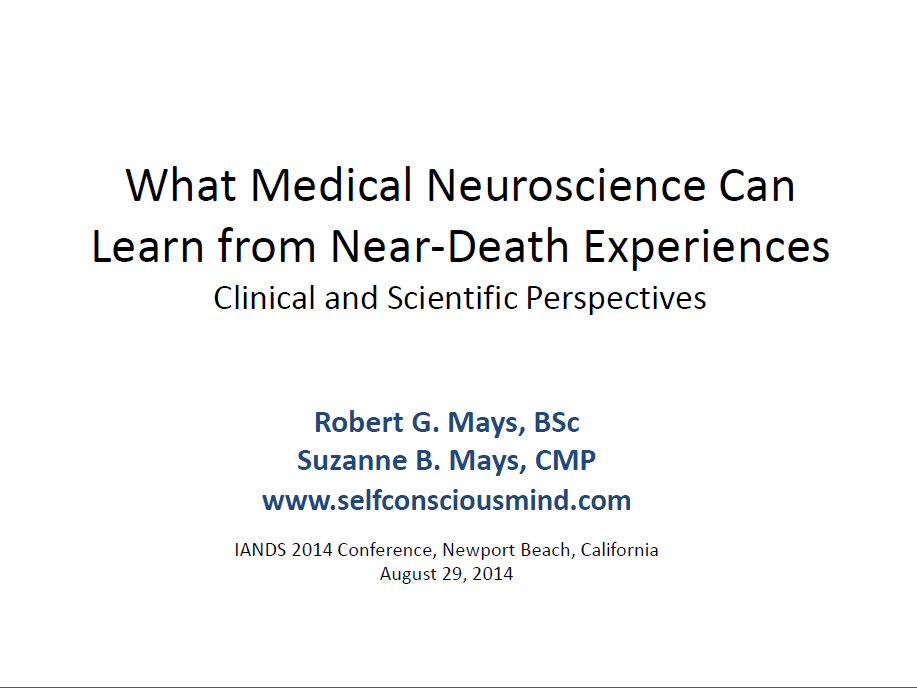 Robert and Suzanne Mays present how
near-death experiences (NDEs) and shared-death
experiences (SDEs) provide several lines of
evidence that suggest that consciousness
separates from the brain and body during these
experiences. The mind-entity hypothesis proposes
that the “mind” is an objective, autonomous
entity that can separate from and operate
independent of the brain. When united with the
brain, the mind can interact with the brain’s
physical processes. The mind is the person’s
seat of consciousness. Robert and Suzanne
propose an interface of the mind with the brain
which can explain a number of open questions
about consciousness and specific neurological
dysfunctions such as Alzheimer’s disease,
addictions and aphasia. They also have
suggestions for developing or enhancing
neurological treatment and therapies.
Color slides ( PDF,
1.4 MB, 28 pages). Video of this presentation
here (59 min).
Solving the
Mystery of Consciousness through Near-Death
Experiences: slides presented in a
workshop at the 2013 IANDS Conference (Arlington,
Virginia,
August-September 2013)
Solving the
Mystery of Consciousness through Near-Death
Experiences: Evidence from NDEs for how
consciousness works
Robert G. Mays, Suzanne B. Mays,
Kenneth Arnette and Eben Alexander
 The nature of consciousness – how
consciousness can arise from matter – is a
mystery to materialist reductionist science.
Near-death experiences (NDEs) provide key
insights into how the “hard problem of
consciousness” can be solved – consciousness
appears to operate independent of the brain.
The problem that must now be solved is: how
does consciousness work with the brain? In
this workshop, we will explore the 3 main
theories that are currently proposed: (1) the
theory of essence (Kenneth Arnette), (2) the
mind-entity theory (Robert and Suz The nature of consciousness – how
consciousness can arise from matter – is a
mystery to materialist reductionist science.
Near-death experiences (NDEs) provide key
insights into how the “hard problem of
consciousness” can be solved – consciousness
appears to operate independent of the brain.
The problem that must now be solved is: how
does consciousness work with the brain? In
this workshop, we will explore the 3 main
theories that are currently proposed: (1) the
theory of essence (Kenneth Arnette), (2) the
mind-entity theory (Robert and Suz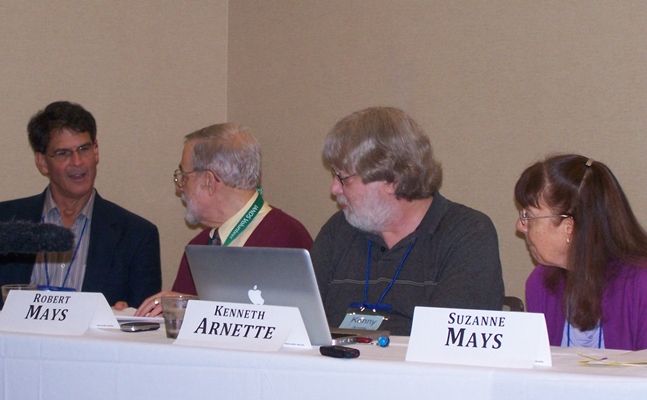 anne
Mays) and (3) the theory of non-local
consciousness (Pim van Lommel and others, with
commentary by Eben Alexander). In the
workshop, there will be ample opportunity for
discussion among presenters and participants,
and questions and answers.
Workshop
discussion anne
Mays) and (3) the theory of non-local
consciousness (Pim van Lommel and others, with
commentary by Eben Alexander). In the
workshop, there will be ample opportunity for
discussion among presenters and participants,
and questions and answers.
Workshop
discussion: (l-r) Eben Alexander,
Robert Mays, Kenneth Arnette, Suzanne Mays.
Color slides (PDF, 1.7 MB, 42
pages). Video presentation to come.
The Future
of NDE and Consciousness Research: slides
presented
at 2012 IANDS
Conference (Scottsdale, Arizona, August
2012)
The Future of
NDE and Consciousness Research: Using the
transcendent content of NDEs to fathom the
mysteries of reality
Robert G. Mays, BSc,
and Suzanne B. Mays, AAS, CMP
 NDE
research
can make progress by examining the
“transcendent” content of NDEs. Four key
anchor points in NDEs convey veridical
information: (1) perceptions of the earthly
realm, (2) communications from apparently
deceased persons, (3) presentations during
the life review, and (4) precognitive
visions that are later proven correct. The
veridical character of the information and
the nearly universal experience of the
hyper-reality of the NDE support the notion
that the NDE is a veridical experience
throughout. Thus a systematic investigation
of the transcendent content of NDEs should
be a fruitful research direction. The “hard
problem of consciousness” is to explain how
neural brain activity can produce subjective
phenomenal experience, such as the
experience of the quality of red. Evidence
from the NDE suggests that the “mind” is an
autonomous, non-material energetic entity
that is ordinarily united with the brain but
separates from it in the NDE. Because the
“mind” is the seat of consciousness and
works with the brain, the “hard problem” can
be solved. The biggest challenge for this
research area is to explain how the
non-material mind interacts with the brain.
Progress is being made in this area. A
related problem is more fundamental – what
is the ultimate nature of reality? Again the
NDE and NDErs can provide a direction for
the “harder problem of reality”: Which
is more fundamental, the physical or the
transcendent? NDErs give a nearly unanimous
response: the transcendent realm of the NDE
is fundamental and more real than the
physical realm. Three paranormal phenomena
that occur as aftereffects in NDErs are
worth studying to understand the nature of
reality: psychokinesis, precognition and
teleportation. The tentative model is: there
are two realms of existence, with the
physical supervenient (dependent) on the
transcendent. NDE
research
can make progress by examining the
“transcendent” content of NDEs. Four key
anchor points in NDEs convey veridical
information: (1) perceptions of the earthly
realm, (2) communications from apparently
deceased persons, (3) presentations during
the life review, and (4) precognitive
visions that are later proven correct. The
veridical character of the information and
the nearly universal experience of the
hyper-reality of the NDE support the notion
that the NDE is a veridical experience
throughout. Thus a systematic investigation
of the transcendent content of NDEs should
be a fruitful research direction. The “hard
problem of consciousness” is to explain how
neural brain activity can produce subjective
phenomenal experience, such as the
experience of the quality of red. Evidence
from the NDE suggests that the “mind” is an
autonomous, non-material energetic entity
that is ordinarily united with the brain but
separates from it in the NDE. Because the
“mind” is the seat of consciousness and
works with the brain, the “hard problem” can
be solved. The biggest challenge for this
research area is to explain how the
non-material mind interacts with the brain.
Progress is being made in this area. A
related problem is more fundamental – what
is the ultimate nature of reality? Again the
NDE and NDErs can provide a direction for
the “harder problem of reality”: Which
is more fundamental, the physical or the
transcendent? NDErs give a nearly unanimous
response: the transcendent realm of the NDE
is fundamental and more real than the
physical realm. Three paranormal phenomena
that occur as aftereffects in NDErs are
worth studying to understand the nature of
reality: psychokinesis, precognition and
teleportation. The tentative model is: there
are two realms of existence, with the
physical supervenient (dependent) on the
transcendent.
Color slides ( PDF, 1.2
MB, 32 pages). Video of this presentation
here (62 min).
NDE
Physical Interaction and NDE Aftereffects: slides
presented
at 2011 IANDS
Conference (Durham, North Carolina,
September 2011)
A Theory of
Physical Interaction in NDE that Explains
NDE Aftereffects
Robert G. Mays, BSc,
and Suzanne B. Mays, AAS, CMP
 We present a
theory of consciousness that the human being
consists of a non-material mind united with
the brain. This theory is based on evidence
of physical interactions in NDE, which shows
(1) how the non-material mind can interact
with neural structures in the cortex, (2)
how the non-material mind can interact with
physical processes during an NDE and (3) how
specific NDE aftereffects can be explained,
such as anomalous electromagnetic
interactions, physiological sensitivities
and paranormal abilities. We also address
how the non-material mind, as the seat of
consciousness of a person, resolves the
“hard problem” of consciousness and how the
mind is fundamentally “localized”, but also
possesses “non-local” properties. We present a
theory of consciousness that the human being
consists of a non-material mind united with
the brain. This theory is based on evidence
of physical interactions in NDE, which shows
(1) how the non-material mind can interact
with neural structures in the cortex, (2)
how the non-material mind can interact with
physical processes during an NDE and (3) how
specific NDE aftereffects can be explained,
such as anomalous electromagnetic
interactions, physiological sensitivities
and paranormal abilities. We also address
how the non-material mind, as the seat of
consciousness of a person, resolves the
“hard problem” of consciousness and how the
mind is fundamentally “localized”, but also
possesses “non-local” properties.
Color slides ( PDF,
1.6 MB, 31 pages). Video of this presentation
here (4 parts, 58 min total).
Theory
of mind and brain: article (September
2011, revised December 2011).
A theory of
mind and brain that solves
the “hard problem” of consciousness
Robert G. Mays, BSc, and Suzanne
B. Mays, AAS, CMP
ABSTRACT: We propose that
the “mind” is an energetic, spatially
extended, nonmaterial entity that is
united with the brain and body. The mind
is a separate entity having the character
of a structured energy field, which can
interact with physical processes including
brain neurons. The nonmaterial mind is
also the seat of conscious experience. The
mind interacts directly with cortical
neurons, probably via electrical
interaction, resulting in both subjective
phenomenal experience and causal influence
on neurological processes. All cognitive
faculties reside in the mind but
ordinarily need the brain's neural
activity for conscious awareness. When
brain structures are damaged, mental
faculties dependent on them are partially
or totally impaired. The main evidence for
this view are phenomena from near-death
experiences and various neurological
phenomena, in particular phantom limbs.
This theory solves the “hard problem” of
how phenomenal experience can arise from
physical brain activity: conscious
experience depends on a second entity with
physical attributes – the conscious mind –
which interacts with the brain to produce
phenomenal experience. Experiences of
qualia, such as redness, are an effect in
the mind resulting from electrical
activity in specific regions of the brain.
The unity of consciousness results from
the unity of the mind's “field of
consciousness”: phenomenal states are
unified in the mind as subject. Causal
closure of the physical is maintained but
the domain of “the physical” must
necessarily be expanded. Mind is a
fundamental entity, a new dimension of
reality.
(PDF
0.5 MB, 25 pages). Video presentation of
this paper here (4 parts, 58 min total).
Mystery of physical
interaction: slides presented at 2010 IANDS
Conference (Denver, Colorado, September
2010)
The mystery of
physical interaction in near-death
experience: implications for
understanding consciousness
Robert G. Mays, BSc, and Suzanne B.
Mays, AAS, CMP
 Slide presentation on evidence of
physical interactions during NDE OBE and in
phantom limbs and the implications for how the
non-material energetic mind interacts with the
brain. Presented at the 2010 IANDS
Conference (Denver, September 2-4,
2010).
Color slides ( PDF,
38 MB, 28 pages) and hand outs (two slides per
page, PDF,
32 MB, 14 pages).
Theory of mind: poster presented at Toward a Science of
Consciousness conference (Tucson,
Arizona, April 13-17, 2010).
A theory of
mind-and-brain that solves the "hard
problem"
Robert G. Mays, BSc, and Suzanne
B. Mays, AAS, CMP
ABSTRACT: We propose that
the human
being consists of (1) an energetic,
spatially extended, non-material “mind”
that is united with (2) a material brain
and body. The mind is a “field of
consciousness”; it is non-material (does
not consist of material atoms) but rather
is a structured, energetic region of space
that can interact with physical processes,
in particular with neurons, and thus has
physical attributes. The mind is united
and co-extensive with the brain and body
and interacts directly with the brain,
probably via electrical interactions with
cortical and other dendritic structures.
 The mind
is the seat of conscious experience.
All cognitive faculties (perception,
thinking, feelings, volition, memory
and self-awareness) reside in the
non-material mind entity, not in the
brain. However, the mind ordinarily is
completely dependent on brain
structures and neural activity for
consciousness. Mental events become
conscious only when there is
sufficient electrical brain activity.
If the electrical activity is not
sufficient, the percept or other
mental event remains subliminal. On
the other hand, the mind can initiate
electrical brain activity and thereby
serves as the agent that initiates
volitional activity, exerts “mental
force”, alters brain neural patterns
plastically, and is the unified
phenomenal field resulting in the
sense of the unity of consciousness. The mind
is the seat of conscious experience.
All cognitive faculties (perception,
thinking, feelings, volition, memory
and self-awareness) reside in the
non-material mind entity, not in the
brain. However, the mind ordinarily is
completely dependent on brain
structures and neural activity for
consciousness. Mental events become
conscious only when there is
sufficient electrical brain activity.
If the electrical activity is not
sufficient, the percept or other
mental event remains subliminal. On
the other hand, the mind can initiate
electrical brain activity and thereby
serves as the agent that initiates
volitional activity, exerts “mental
force”, alters brain neural patterns
plastically, and is the unified
phenomenal field resulting in the
sense of the unity of consciousness.
When brain
structures are damaged, mental
faculties dependent on them are
partially or totally impaired, due to
interference with the interface
between the neurons and the mind.
The field of the mind has an internal
structure which corresponds to the
cortical and other neural structures of
the brain. In fact, it is likely that
the internal structure of the mind’s
field directly maps to the neural
structure throughout the body. The mind
depends on brain neural activity in
particular cortical locations for
particular cognitive functions.
In
support of this theory, we provide
evidence from near-death experiences
(NDEs), the aftereffects of NDEs and
from various neurological phenomena. In
particular, we provide evidence of
interaction of the non-material mind
entity with physical processes, in NDE and
phantom limb phenomena.
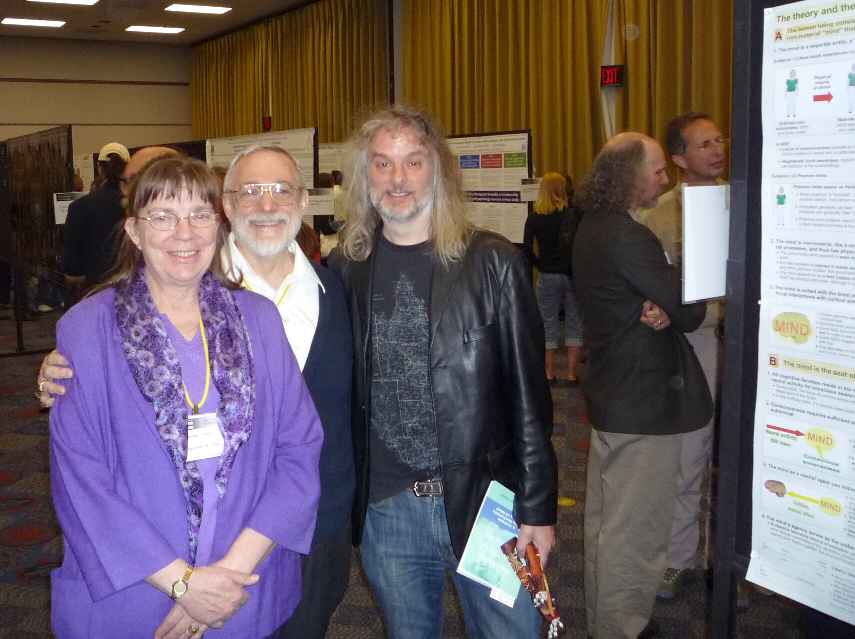 This
theory solves the “hard problem” of
how conscious experience can arise
from physical brain activity
– conscious experience depends on a
second entity with physical
attributes, the conscious mind, which
interacts with the brain to produce
phenomenal experience. Subjective
experiences of qualia are an effect in
the mind resulting from neural
electrical activity in specific
regions of the brain. A philosophical
zombie duplicate of a person is
impossible because a physical
duplicate would necessarily include a
conscious mind as well as a physical
body and thus would entail conscious
experience. The unity of consciousness
results from the unity of the mind’s
“field of consciousness”. The mind is
the subject in whom phenomenal states
are unified. This
theory solves the “hard problem” of
how conscious experience can arise
from physical brain activity
– conscious experience depends on a
second entity with physical
attributes, the conscious mind, which
interacts with the brain to produce
phenomenal experience. Subjective
experiences of qualia are an effect in
the mind resulting from neural
electrical activity in specific
regions of the brain. A philosophical
zombie duplicate of a person is
impossible because a physical
duplicate would necessarily include a
conscious mind as well as a physical
body and thus would entail conscious
experience. The unity of consciousness
results from the unity of the mind’s
“field of consciousness”. The mind is
the subject in whom phenomenal states
are unified.
All
interactions in the mind have two sides:
they entail both phenomenal experience and a physical
causal role. Physical causal
closure is maintained because the mind is
a non-material entity with physical
attributes, whose structures can act
causally on neural processes. The domain
of what constitutes “the physical” must
necessarily be expanded.
(PDF
1.1 MB, 10 pages). See also our Introduction
for details of this theory.
NDEs
and consciousness: slides
presented at 2009
IANDS Conference (San Diego,
California, October 2009)
What NDEs tell us
about consciousness
Robert G. Mays, BSc, and Suzanne B.
Mays, AAS, CMP
 Slide
presentation overview of our current theory of
the self-conscious mind, presented at
the 2009
IANDS Conference in San Diego, CA,
October 16-17. Color slides ( PDF,
10.7 MB, 19 slides) and hand outs ( PDF,
5 MB, 10 pages).
Published in the Journal of
Near-Death Studies, 27(1), 5-45
(2008).
The
phenomenology of the self-conscious mind
Robert G.
Mays, BSc, and Suzanne B. Mays, AAS, CMP
ABSTRACT:
The phenomenon of a near-death
experiencer’s veridical perceptions
during the out-of-body experience (OBE)
strongly suggests the existence of a
self-conscious mind as a ‘‘field of
consciousness,’’ a region of space where
a person’s consciousness exists. In the
out-of-body state, the mind appears to
be nonmaterial and completely
independent of the physical body.
Ordinarily, though, the self-conscious
mind appears as an autonomous entity
united with the brain and body. In this
united state, the self-conscious mind
operates through the mediation of the
brain. This view is supported by
evidence from neurological phenomena
such as subjective antedating of sensory
experiences and mental force. This
evidence suggests that a nonneural
agency induces conscious experience and
self-conscious awareness. Phenomena from
OBEs, including apparent subtle
interactions with physical processes
such as light, sound, and physical
objects, as well as reported
interactions with ‘‘in-body’’ persons,
support the view that the self-conscious
mind is able to interact in some
physical way with the brain.
Neurological phenomena such as Benjamin
Libet’s (1985) delayed awareness of
willed action can be reconsidered
successfully in light of this view. Such
efforts might also prove useful, for
example, in explaining phantom limb
phenomena.
Reprint ( PDF,
250 KB, 41 pages)
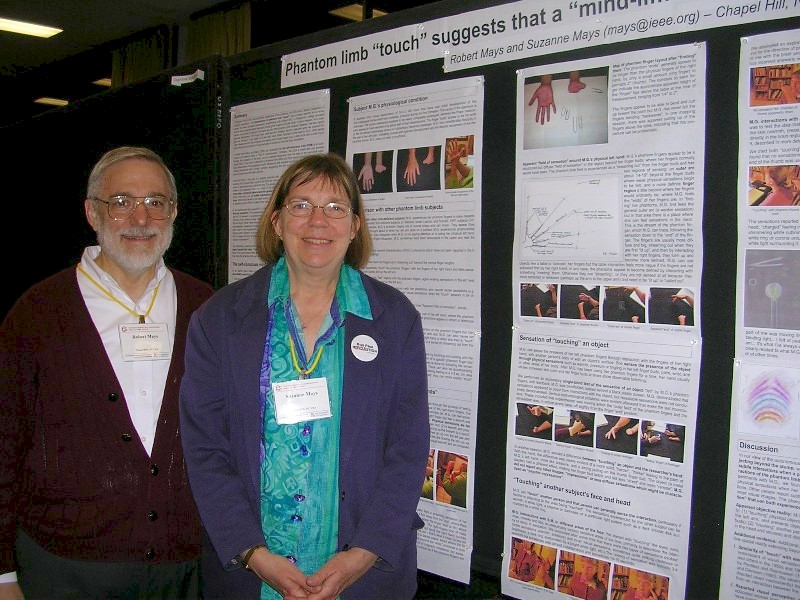
Phantom limb
research: poster presented at the
Toward a Science of
Consciousness conference (Tucson,
Arizona, April 8-12, 2008).
Phantom limb
"touch" suggests that
a "mind-limb" extends beyond the
physical body
Robert G.
Mays, BSc and Suzanne B. Mays, AAS, CMP
ABSTRACT: A phantom
limb is the vivid subjective experience of the
presence of a limb that is absent
congenitally or through amputation. The
phenomenon of phantom limb "touch" has not
been reported to our knowledge. We have
completed exploratory experiments with subject
M.G., a 56-year-old, college educated woman
with congenital unilateral adactylia (missing
five fingers of the left hand). In many
respects, M.G. experiences her phantom fingers
in the same way as other phantom limb
subjects. However, she also reports physical
sensations in her finger buds, palm and arm
(tingling, warmth, pressure) when her phantom
fingers are "touched" by an object or by her
right hand. When "touched" on the head by
M.G., other people report feeling warmth and
pressure, and seeing inner visual images
(e.g., a dark circle with a white ring of
light) which are reminiscent of visual
sensations evoked by electrical brain
stimulation,
 In earlier work (Mays
and Mays, 2008), we postulated that the
self-conscious mind (SCM) is an autonomous
"field of consciousness" which ordinarily is
united with and operates through the mediation
of the brain, but which separates from the
body in the near-death experience (NDE). This
view is supported by evidence from NDEs and
from various neurological phenomena. NDE
phenomena include apparent subtle interactions
with physical processes (light, sound,
surfaces), including interactions with
"in-body" persons, suggesting that the non-material
SCM is able to interact in some physical
way with brain neurons. In earlier work (Mays
and Mays, 2008), we postulated that the
self-conscious mind (SCM) is an autonomous
"field of consciousness" which ordinarily is
united with and operates through the mediation
of the brain, but which separates from the
body in the near-death experience (NDE). This
view is supported by evidence from NDEs and
from various neurological phenomena. NDE
phenomena include apparent subtle interactions
with physical processes (light, sound,
surfaces), including interactions with
"in-body" persons, suggesting that the non-material
SCM is able to interact in some physical
way with brain neurons.
Since the SCM in this view
is a spatially extended field, coextensive
with the physical body, then in the absence
of a physical limb, a part of the SCM will
still project beyond the stump as a kind of
"mind-limb" which is experienced as a
phantom limb. The spatial region of the
phantom/mind-limb then should exhibit some
of the properties of the SCM "body" in the
NDE out-of-body experience, such as subtle
interactions when a physical object enters
the spatial region of the phantom, possibly
causing physical sensations in the
body, and subtle interactions of the phantom
limb with another person's physical body,
which could be felt by the other person.
In our experiments
with M.G., we found preliminary evidence
supporting both of these properties. M.G.
reports physical sensations in her finger
buds, in her left palm, along the left arm
and in a specific spot in her upper left
arm, when her phantom fingers are "touched",
and presents objective physiological
reactions (increased skin color, twitching
of the finger buds). Other people reported
subtle but definite physiological sensations
(warmth, pressure in the head and sinuses,
unusual inner visual images) when "touched"
on the face or back of the head by M.G.’s
phantom fingers. The visual images include
shadows, light, dark circle with white ring,
gradually progressing oblique white lines
forming a sword-like shape, gradually
forming channel rising from abdomen up and
ending with bright white light in the head,
and arcs of colored light rising up with
changing colors.
In
this paper, we present the detailed
phenomenology of phantom limb "touch" and
address alternate explanations.
(PDF
3.3MB, 12 pages).
Original
paper: submitted for
consideration to the Journal of
Near-Death Studies on October 22,
2006. The recommendation was to reduce
the paper considerably and revise the
neurologically based arguments, which we
have done. The original paper is now out
of date.
The
phenomenology of the independent
self-conscious mind (original
draft,
PDF
530K, 47 pages)
Robert
G. Mays, BSc, and Suzanne B. Mays, AAS,
CMP
ABSTRACT: The out-of-body phase of the
near-death experience, where the locus of
awareness is no longer in the body,
provides details of the phenomenon of the
independent self-conscious mind. With
these details, one can isolate the
attributes and faculties of the
self-conscious mind from those of the
brain. The phenomenology of the
out-of-body experience thus acts as a
Rosetta stone in deciphering mind-body
phenomena. This view is very similar to
the dualist interactionist model of Popper
and Eccles (1977) but with several
differences. Counterintuitive mind-body
phenomena such as antedating and apparent
delays in awareness of voluntary actions
can be reassessed, showing that the
non-material mind is accessible to
scientific study. The objection that the
operation of a non-material self-conscious
mind within the brain violates the current
laws of physics is probably correct: the
independent self-conscious mind
constitutes a new dimension of reality and
current physical laws need to be extended,
as they have been in the past, to
encompass the new phenomena. The laws of
mind and the mind’s relationship to the
physical dimension of reality need to be
investigated scientifically. The proper
way to do this is to investigate the
phenomena of mind and body in detail.
Consideration of the independent
self-conscious mind in mind-body phenomena
should give useful insights into a number
of ordinary mental phenomena such as
memory processes, and into solutions to
problems such as effective strategies for
treatment of autistic spectrum disorders
or for rehabilitation from stroke.
Hints for
printing papers in Adobe Reader:
we suggest that you use the Adobe print setting
of "Page
Scaling = None", because the pages are
already scaled properly for 8.5 by 11 paper. If
you'd like to save paper, we also suggest
printing all the odd pages first using the "Subset = Odd pages
only" setting, then turn the paper
around, put it back in the printer feeder and
use "Subset =
Even pages only".
|